orders@wingleader.co.uk
Heinkel He177A-5
Werknummern (serial): 550215
F8+FH, 1./KG40
Pilot: Ofw. Werner Neuenfeld and crew (survived)
Date: 13th June 1944
Place: Bolbec, France

On 12th June 1944, Ofw. Werner Neuenfeld and his crew took off from Toulouse to attack invasion shipping off the Normandy coast with Hs293 Fritz-X missiles. As they approached Le Havre, the He177 was intercepted by a Mosquito crew from 410 (RCAF) Squadron, which had taken off from Hunsdon, England.
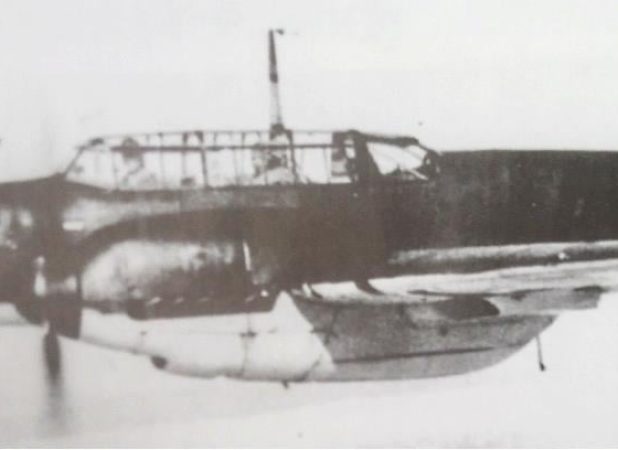
P/O. Kearney was guided onto the He177 by his AI operator, F/O. Bradford, from two miles away, and closed to just 600 feet to make a positive identification of the target, which was observed to have ‘an object slung outboard of each engine’ – the Hs293s.


The first burst of P/O. Kearney’s fire missed, but a second set the whole starboard wing root and engine on fire. The bomber then went down in a steep dive from 6,000 feet, with the flames spreading, until it hit the ground, exploding with such force that the Mosquito was shaken by it.
It would seem likely that return fire had damaged the Mosquito as both engines began to fail, forcing P/O. Kearney to make a wheels-up landing at a landing ground on the beachhead. As the Mosquito slid along the ground, it collided with a truck, killing the luckless driver.


The He177′s crash site had been located by historian Laurent Viton and was excavated in September 2012. All four DB605 engines were recovered, together with the propeller hubs, gearboxes, and the drive shafts that coupled them. Also recovered were two of the huge undercarriage legs.
The engines were buried vertically at a depth of 2 metres, and in the centre of the crater, the tail wheel leg was discovered.