orders@wingleader.co.uk
Supermarine Spitfire IIa
RAF Serial: P7533
57 OTU
Pilot: Sgt. Douglas Couper Goudie (survived)
Date: 14th October 1942
Place: Birkenhead Park, Wirral
An abandoned Spitfire performed an aerobatic display before crashing to earth in a Birkenhead park. The events were witnessed by a local boy, who went on to found the Warplane Wreck Investigation Group. Sixty Five years later, the aircraft was excavated by his son.

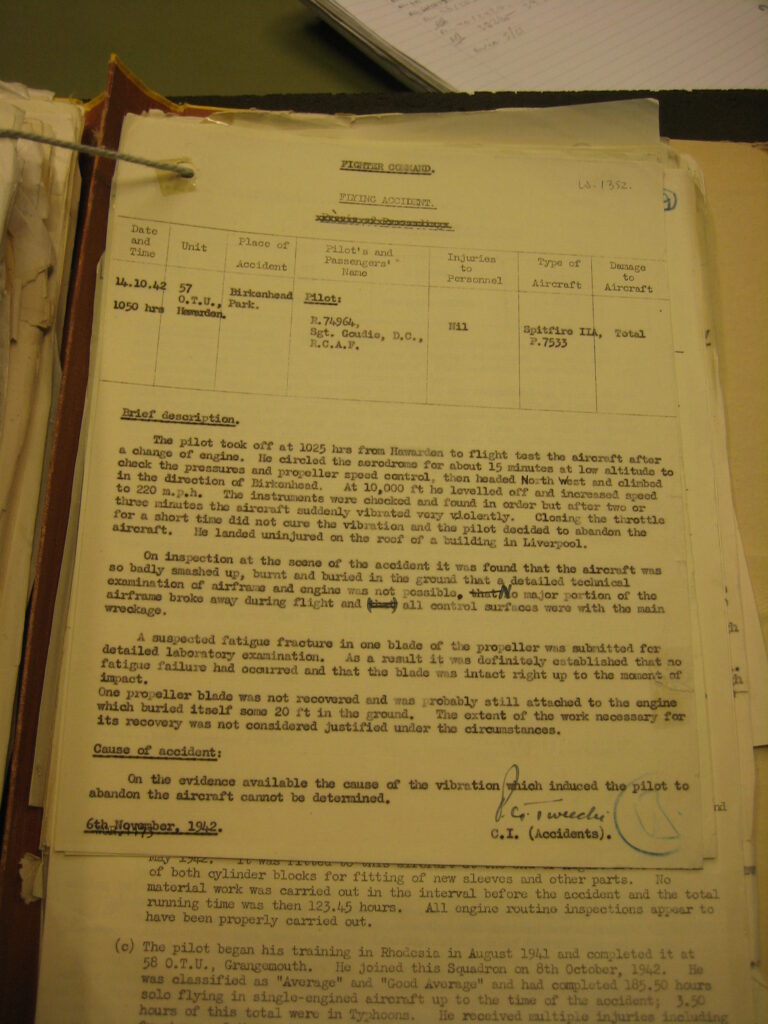
A Spitfire MkIIa was excavated by the Warplane Wreck Investigation Group on October 6th, eight days before the 65th anniversary of it’s crash. The aircraft was on an engine test from 57 Operational Training Unit at Hawarden. The pilot, Sgt DC Goudie, Royal Canadian Air Force, climbed to 10,000″ over Birkenhead when the aircraft started to vibrate violently. Unable to maintain control and with the danger of the aircraft disintegrating he baled out. The Spitfire performed a brief unmanned aerobatic display, watched by many eyewitnesses on the ground before diving into the southwest corner of Birkenhead park and destroying itself completely. The accident investigation board found enough of the control surfaces to rule them out as a cause but stated. “One propeller blade was not recovered and was probably still attached to the engine which buried itself some 20 feet in the ground.”
Birkenhead has the only grade one listed park in the country, which made arrangements for the dig challenging. Two years of letters and meetings were needed to gain all the necessary permissions. The founder member of WWIG was one of the eyewitnesses to the crash and his son organised the excavation in memory of his late father.
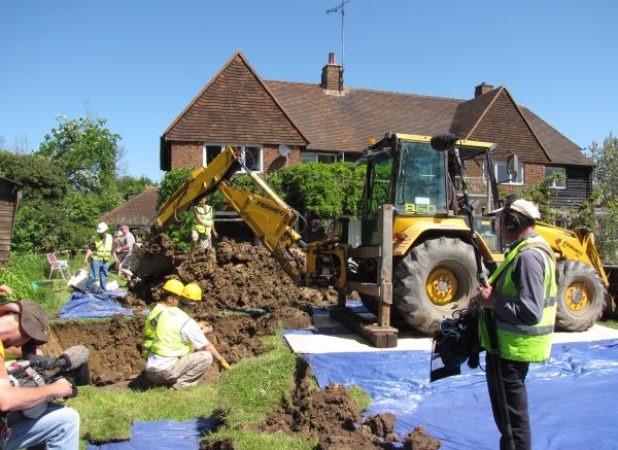
The exact site proved difficult to locate.The park had been landscaped since the war, but was still littered with steel AA shrapnel which confused the magnetometers being used. The first promising reading proved to be a (probably not Supermarine) goalpost. The site was eventually pinned down to an area of household rubbish and backfill just under the turf. At a depth of only a foot a strong smell of aviation fuel wafted out and proved the magnetometer signal was not a manhole cover. There were traces of corroded aluminium beyond this and the digger was brought in. There were only tiny fragments down to five feet before the perfectly preserved tail wheel damper and a section of tailplane emerged from the now thick clay. The tail section carried a lovely label stating ‘Castle Bromwich Aircraft Factory, Birmingham’. Just below these fragments the whole Spitfire emerged, compressed into a twisted ball no more than four feet thick. The digger cleared the area to the sides before exposing the wreckage. Amongst the items immediately visible were the prop boss, oxygen and compressed air bottles, supercharger impeller, radio aerial and rack and cockpit door. Most of the fuselage skinning had been stripped away presumably nearer the surface, although one section sill carried yellow paint from the roundel. Lifting the mass of wreckage out of the hole allowed the smaller items to be recovered, including an almost full set of cockpit instruments, undercarriage selector, throttle box and even the leather and horsehair stuffed seat padding. Interestingly the Spitfire still had it’s Supermarine embossed rudder pedals, a real joy to see. Unusal equipment included the MkII specific landing light controls and coffman starter.
The Merlin 12 came out in excellent condition and will be displayed at the Fort Perch Rock museum at Birkenhead, along with a display of the recovered wreckage. Examining the prop hub revealed two sheared propeller stubs and one empty socket. It looks as if loss of a complete blade caused the vibration which lead to the crash.
Thanks go to Doug Darroch and the WWIG team for the invitation to attend a very memorable excavation.

excavation

eventually located around 100 meters from the given location

surface, making locating the site difficult
Eyewitness Bobby Boyd recalled that “[he] and many others who saw the aircraft crash ran to the park to see a smoldering hole in the ground.”
After two years of planning by Doug Darroch, the excavation was undertaken with the cooperation
of Wirral Borough Council and the Merseyside Archaeological Team. The recovered items will be put
on display at the Warplane Wreck Investigation Group Museum at Fort Perch Rock, New Brighton.