orders@wingleader.co.uk
Curtiss Mohawk
RAF Serial: BK877
A&AEE
Pilot: S/Ldr. John Edgar Dutton (killed)
Date: 1st March 1941
Place: Wiltshire, England
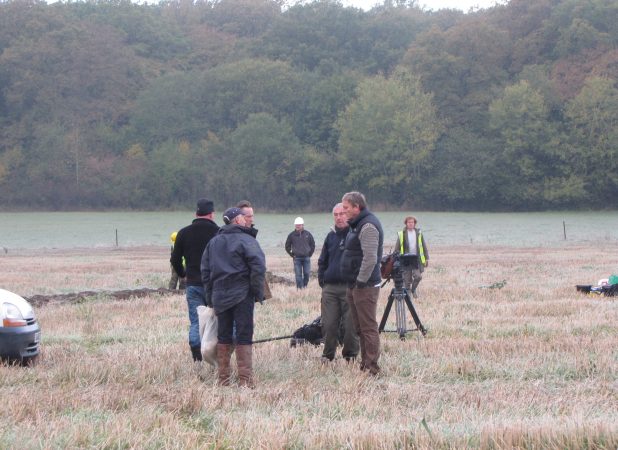
In early August, the owner of the land at Hanging Langford was kind enough to allow the excavation of a World War II aircraft which had crashed on her land some 65 years prior. The recovered pieces have begun to unravel the story of a tragic accident.
On the 1st March 1941, a Curtiss Mohawk fighter aircraft took off from Boscombe Down airfield. Its pilot, Squadron Leader John Edgar Dutton, was an experienced test pilot who had been awarded the Air Force Cross medal earlier in the year. The purpose of the flight was to test the heating equipment for the aircraft’s six Browning machine guns, as the guns often froze in the cold air above 20,000ft.

During the flight, a fire started on board. At 10:30 in the morning, the Mohawk was seen to dive, burning, out of the cloud base and bury itself in a large crater. Mr Edmund Tibbotts, a dairyman working on the water meadow next to the river Wylye, witnessed the crash. His witness testimony was called on in the following Air Force investigation, and what he had seen made such an impression on him that he passed the story down to his daughter-in-law.
Whilst looking for another aircraft, a Spitfire which had crashed ‘near Codford’, members of the Marches Aviation Society made an appeal for information in the local press. As well as leads which located this aircraft, they were also contacted by a Mrs Jean Twigg from Andover. She was Mr Tibbott’s daughter-in-law, and, over the coming months, she not only returned to Hanging Langford to refresh her memory but also contacted the landowner, Miss Dixon, and identified the spot where the plane had come down.

All that was left to do was to identify what this mystery aircraft that had dropped from the sky was. There were two ways forward: to examine the records of every aircraft which came down in Wiltshire (many hundreds) to check for mention of Hanging Langford, or to identify the aircraft from the small parts left behind. The latter was chosen.


The Marches Aviation Society is a group of individuals dedicated to recording and remembering the sacrifices made in the air over Britain during World War II. The recovery and preservation of crashed wartime aircraft is known as Aviation Archaeology and is overseen by the British Aviation Archaeological Council and the Ministry of Defence, who still claim ownership of these long-forgotten fragments. Over the years, they have amassed a great deal of information and knowledge and were put to the test with Mrs Twigg’s mystery plane.


A morning spent with a metal detector found a surprising amount of the aircraft lying just under the turf. A shiny black push rod suggested an American aircraft, with a radial air-cooled engine; yellow-painted aluminium suggested a British training aircraft (which were painted yellow underneath as an ‘L’ plate style warning); the recoil buffer from a British .303 machine gun showed the plane was armed, and a stainless steel ammunition track again pointed to American manufacture. This suggested that the plane was either an RAF Miles Master trainer, some of which were fitted with American engines, or, more likely, a Harvard, an American training plane bought and flown by the RAF. According to the available records, neither of these types had crashed near Hanging Langford. It was only when cleaning a rather unpromising-looking access panel that the yellow paint washed away to reveal the legend ‘Vidanger de….’
Unmistakably French, but how?


With war clouds looming in the late 1930s, the French government realised that it did not have enough modern fighting aircraft to defend itself. They turned to America and ordered large numbers of Curtiss H75 Hawk fighters (the Curtiss sales brochure was apparently a joy to behold). By the time the Nazi Blitzkrieg struck in 1940, the French had several squadrons of Hawks in service, but this was still only a small part of their order. French Hawks shot down the first Luftwaffe aircraft of the campaign and accounted for more Germans than any of the home-produced Morane-Saulnier or Dewoitine fighters, but could not stem the flow. With the surrender of France, some pilots flew their aircraft to Britain, although more sided with the Vichy government in the south of France. These Vichy Hawks were later flown against the Allies in North Africa, one of only a few types to serve on both sides during the war. The US Air Force was still flying Hawks in 1941, and it was one of these which shot down a Japanese dive-bomber during the attack on Pearl Harbour. The remaining French Hawks were shipped directly to Britain, still in French camouflage and with French instruments and equipment. One of these was tested at Boscombe Down against a Spitfire, and, as a result, the type was deemed unfit for service in Europe and the remaining Hawks, or Mohawks as they were named in RAF service, were shipped to Asia to fight the Japanese.
With the knowledge that the Hanging Langford plane was an American aircraft built for the French, it was quickly identified as a Mohawk. It was Serial No. BK877 of the Aircraft & Armament Experimental Establishment at Boscombe Down. It had also been excavated in 1980 by the London Air Museum, who had removed the engine, propeller and cockpit. The only mystery left was whether the aircraft was one of those which had served in the Battle of France or one of the later batches which had been shipped directly to the UK. Despite having been dug previously, a deep seeking metal detector, a government surplus bomb locator, showed there was a lot of wreckage remaining, and so, with Miss Dixon’s permission, a licence was obtained from the MOD to excavate.


Aviation archaeology differs from traditional archaeology in many ways. Depending on the type of crash and ground conditions, several tons of an aircraft can often be found. Instead of a trowel and brush, a JCB is often used, and, in this case, Digger Martin did a superb job of extracting the aircraft from the ground.
The dig started smoothly with the topsoil removed and pieces of aluminium structure quickly appearing. Amongst the first identifiable pieces of plane were a magneto from the engine, the British throttle control from the side of the cockpit (a replacement for the French unit, which worked backwards), and the label from the fire extinguisher, manufactured in Detroit but with the operating instructions in French.
With the excavation down to 5”, the water table made its presence felt, with the hole quickly filling up nearly to ground level. From then on, Digger gave the impression of fishing in soup, pulling out buckets of mud and water with fragments of aircraft mixed up amongst it. This made it very difficult to identify pieces, and the wreckage was simply loaded into trailers for later cleaning.

One piece had a manufacturer’s label showing that the Mohawk was the 99th A-4 model and had been completed in May 1940. This meant that it could not have been shipped across the Atlantic in time to reach the Battle of France.
Big pieces included a self-sealing fuel tank from the wing and some large pieces of the cockpit floor. Some of the items were in a perfect state of preservation, still shining after 65 years, whereas other sections had corroded away to nothing. Amongst the mud-encrusted pieces were the pedals and seat of a bicycle, and a garden hoe – not standard RAF equipment! A surprising and slightly alarming find was four of the aircraft’s six .303 Browning machine guns, the last sticking out of the digger bucket like a cocktail stick. These are now with a firearms dealer who is deactivating them to comply with the law.
In all, about a ton of wreckage was recovered, and pressure washing it over the following days revealed more of its history. A flattened stainless steel box contained fired bullet cases, all dated 1940, which were the results of the gun testing on the final flight. Painted panels had more French instructions on them, as well as showing parts of the camouflage pattern the plane was delivered in. It could be seen where the RAF fitters had masked the underside of the aircraft before spraying it, with over-sprays of yellow paint on the silver wheel rims. The most telling of all was the blackening on some of the structure where it had been touched by fire, particularly on the cockpit floor and wing root. One of the wing ribs had melted through, leaving a blob of once liquid metal.
Test pilots would always try to bring an aircraft back for analysis rather than abandon it and lose the results of their work. It seems that Squadron Leader Dutton was killed trying to bring his burning aircraft back to base.
There is now a museum at Boscombe Down Airfield, and it is fitting that some of the larger pieces will be returned there after 65 years away. A more local commemoration of the event will be the unveiling of a memorial plaque on a section of Dutton’s aircraft in Hanging Langford church – a reminder of a tragic, but all too common event.
We shall remember them.