orders@wingleader.co.uk
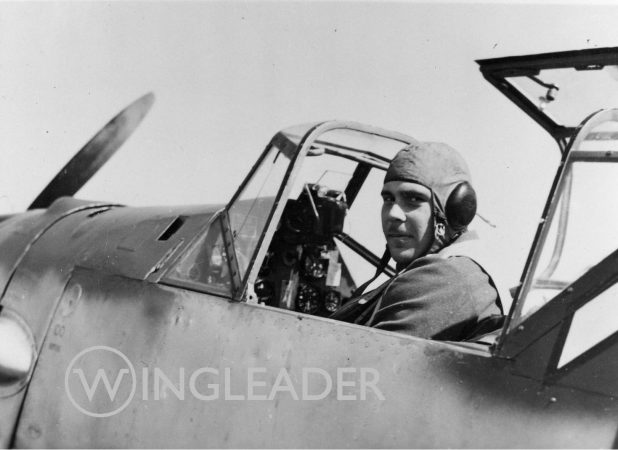
Messerschmitt Me109
Werknummern (serial): 5395
Crew: Obltn. Erich Kircheis, injured.
Date: 28th August 1940
Place: Kayle Field, 127 yards east of the A260, Selsted, Folkestone
This story comes from the archives of the late Peter Foote, a friend whose remarkable Second World War collection now resides in the Wingleader collection. Foote attended the 1972 excavation at Kayle Field, interviewing an eyewitness, and documenting the recovery of this Messerschmitt Me109 with the Tenterden and Ashford Aircraft Recovery Company.

On the 28th August 1940, the doomed Me109 crashed in Kent between 9:30–10:00am following a dogfight overhead. The only eyewitness interviewed was Mr Arthur Herbert Edney, commonly known as “Bob”, of Selsted Farm. At the time he was approximately 67 years old, having started work on the farm during WWI driving horses at the age of 11, because so many men had gone off to war. He became established there in 1921.
On the day in question, Mr Edney was in an adjoining field, some 25-50 yards from the impact point, driving a horse-drawn water cart with fellow farm worker “George.” Just previously, he had chased escaped sheep out of Kayle Field. He recalled a dogfight taking place overhead, then saw the Me109 approaching from the northwest. By the time he had looked back to halt the horse, the aircraft had already hit the ground. There was not much noise; he stated that those in Selsted heard the bang louder.
He went over to the hole where flames were rising around ten feet into the air. His friend George had always said he wished one would fall close so they could “have a good look at one at close quarters.” Mr Edney was struck on the shoulder by a piece of spinning wreckage while standing behind the horse, but luckily wasn’t injured. The horse took no notice. Shrapnel had been falling during the earlier battle, some close by, but neither man nor horse reacted. “You couldn’t do,” he said, “otherwise we wouldn’t get anything done.”

Mr Edney saw a Hurricane pursuing the doomed aircraft, and also witnessed the German pilot descending by parachute to the northwest, landing at Galtridge Farm. The pilot was described as a young 18-year-old who could speak English. At Tafferington Hall Farm lived Mrs Tyler, who could speak German and attempted to talk with him, but soldiers who had taken him prisoner quickly forbade this.
Although Mr Edney could not initially recall the date, he later remembered that Miss Shepherd, daughter of the Keeper, had married a soldier that day at Dunton Church. On Sunday 8th October 1972, he spoke with the other spinster daughter who was still living in Selsted, and she confirmed the marriage date as 28th August 1940.
After the crash, soldiers arrived and asked if Mr Edney had seen the pilot. They removed a fire extinguisher from their lorry to attempt to put out the fire, but no other fire service attended. Coincidentally, the married couple, Mr & Mrs Butters, and the pilot later travelled on the same train up to London, most likely leaving from Folkestone.
Mr Edney bought the field in 1947. By the time of the recovery it carried electrical power supply lines. The soil was brown clay, with pieces of wreckage of all shapes and sizes appearing, the deeper one dug. A crop of corn had recently been cut from the level field of around two to three acres.
The engine was finally pulled from a depth of 16 feet at midday on Sunday 8th October 1972 during a dig carried out by the Tenterden and Ashford Aircraft Recovery Company, which Peter Foote attended.

A considerable amount of wreckage was recovered, including two MG17s which were taken into police custody. A cannon in good order was also found, along with two ammunition drums near a slot mounting and fired 20mm cases, indicating buried wings. Both fired and unused ammunition was extracted, with a remarkable number of rounds dated 1937 and 1939. A Very pistol and cartridges dated 1943 were also recovered.


Further items included battery casing with leather handle, rudder horn balance, tail components, tail cone, tail frame adjusting jack, port fuselage side showing evidence of fire blistering, propeller hub, a separated prop blade (one later given to Mr Edney as a keepsake), cockpit lights, canopy handle, first aid pack, oxygen bottle dated 12.39, and two halves of armour plate – one bearing a fresh bullet scar flattened sideways.
The engine had broken apart, with crankshafts and front cylinders eroded, some camshafts separated, and a cog pulled off by the digger. Some components were perfectly preserved, others heavily corroded. A wing carried a WMF (Wiener Neustädter Flugzeugwerke) label, as did one engine component. Cowling around the exhaust manifold showed black paint with yellow wash applied, blistered by heat.

Despite extensive searching, no Werknummer was located on site. David Buchanan later confirmed this on 13th March 1973. However, some four years later, on 16th December 1977, a WM5395 label was found in port fuselage wreckage.
Tragically, Mr Edney reportedly suffered a heart attack and died only about a week after the 1972 interview.